
Verified by Accountable HQ · BAA required for clinical partners · [email protected]
167 hours. That's how long your patient lives between sessions. Lisner gives you visibility into all of it.
Advised by a health-system Chief Medical Officer and the former Chief Clinical Officer of a national trauma nonprofit.
Your patient was in crisis at 2am on Tuesday. You won't find out until Friday's session — if they remember to mention it.
Present in the 167 hours when you can't be. Your patient speaks when they need to — at 2am, after a hard conversation, mid-panic — and Lisner holds it until your session.
Lisner is built with — and answerable to — practicing clinicians and clinical leaders.

"I'm exploring how technology can thoughtfully support the therapeutic process while keeping the therapeutic relationship at the center of the work. Lisner helps bridge the gap between sessions — without getting in the way of it."

"Every week I build a plan for a client with almost no idea what has happened since I last saw them. That is where most of the leverage in treatment is being lost — not in the hour, but in the other 167. Lisner takes that problem seriously and takes the clinician's judgment seriously at the same time."

"What is unusual about Lisner is that patient consent and clinician judgment are design constraints rather than compliance afterthoughts. In my experience that is the difference between a tool that survives contact with a real practice and one that does not."
In behavioral health, so much lives in the space between visits — the quiet details, the moments patients try to remember but can't fully reconstruct. A tool that helps patients capture their lived experience in real time has the potential to bring more clarity, more continuity, and a deeper sense of being understood. That alone can strengthen the therapeutic relationship in a powerful way.— Program Director, Psychiatry Residency & Clinical Chair of Behavioral Health (Design Partner under NDA)
The Dashboard
Open Lisner 5 minutes before your first session. Acuity indicators, biometric trends, and thought summaries — everything you need, nothing you don't.
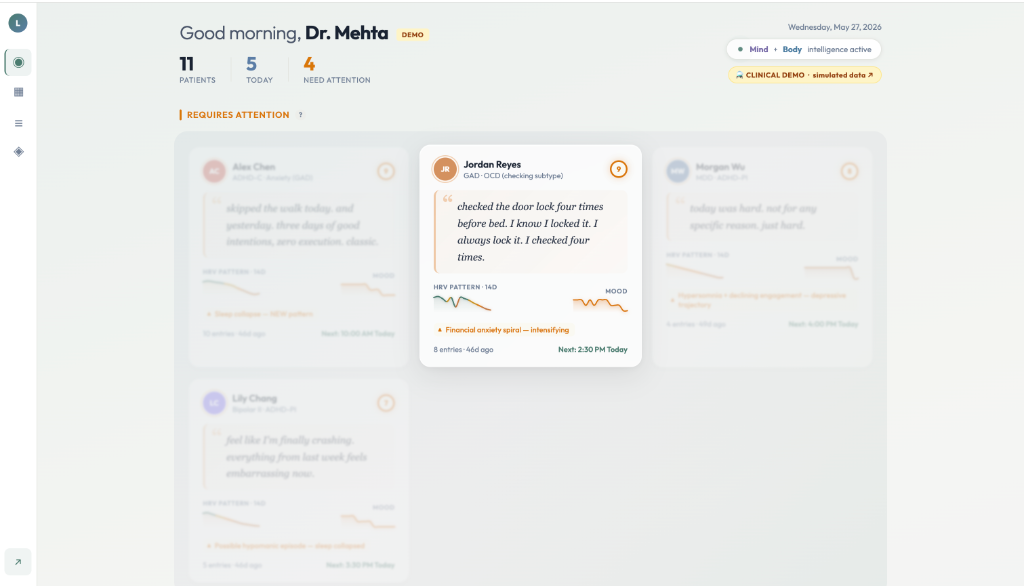
AI Briefing
Open any patient. The AI briefing surfaces what matters before your session — actionable, structured, ready to review.
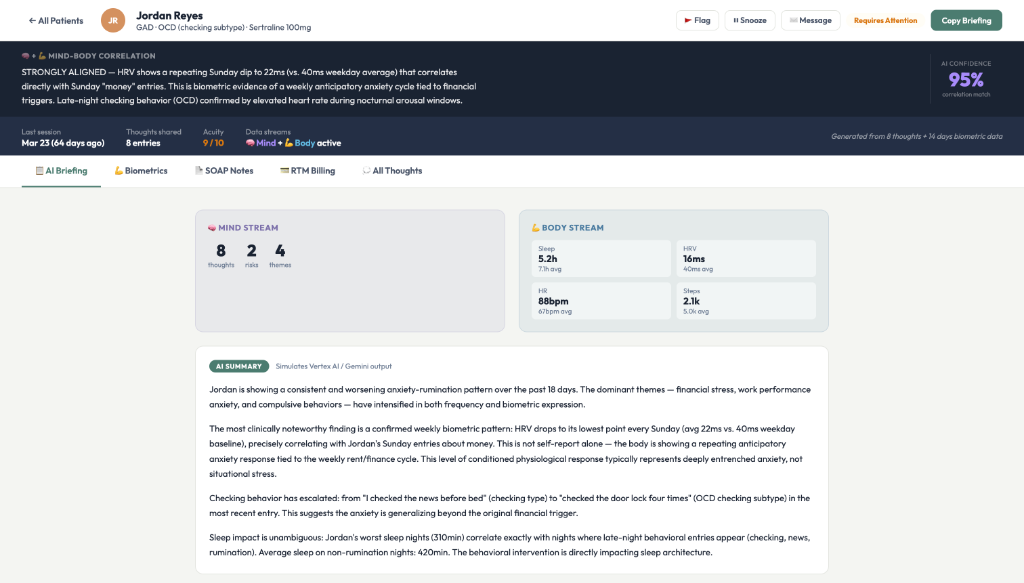
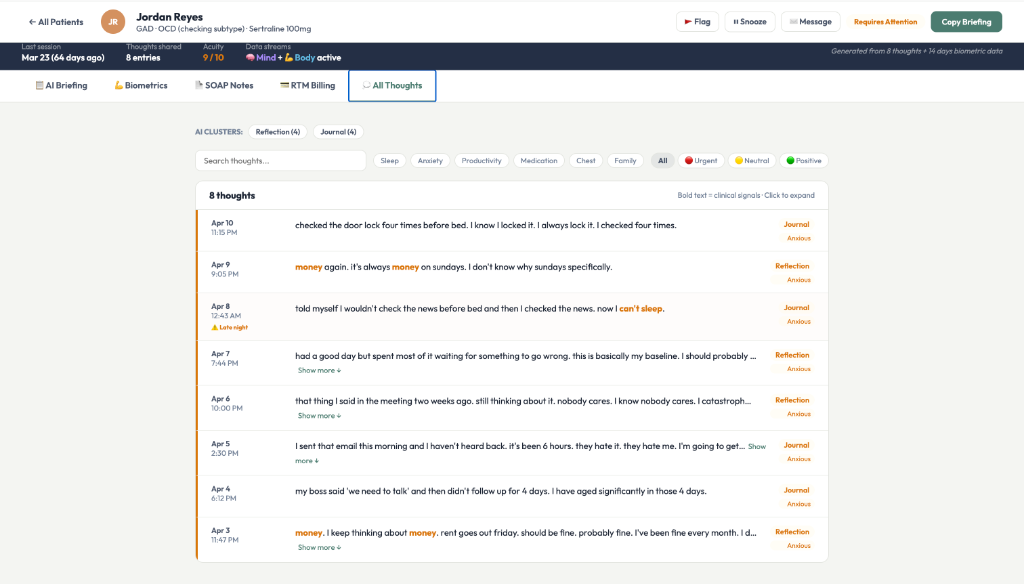
All Thoughts
AI organizes patient thoughts by theme and clinical relevance. Visual cues help you spot what matters first. Searchable, filterable, expandable.
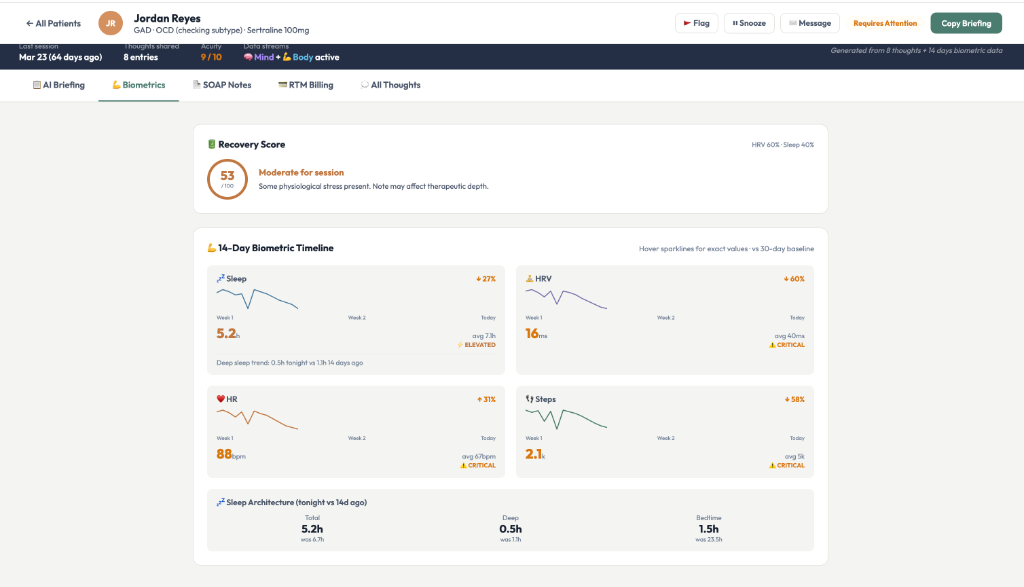
Biometrics
14-day biometric timeline with dynamic alerting. Recovery score combines key health signals to inform your session — know before they walk in whether today calls for grounding work or deeper clinical processing.
What Lisner Captures
Every signal your patient chooses to share between sessions, summarized in three core dimensions.
Unfiltered access to what your patient is thinking between sessions — in their own words, at the moment it happens. Not a late-session reconstruction, but their actual lived experience.
Objective physiological data — sleep architecture, stress recovery, and physical activity. See subjective journals alongside objective physiological markers.
Lisner highlights entry frequency anomalies, emotional shifts, and biometric changes. We surface clinical indicators so you can visual-triage before sessions.
Simple for the patient. Powerful for the therapist.
Introduce Lisner to your patient as a private tool for between-session reflection. Simple to start, no structural changes required, and entirely in the patient's control.
The patient records thoughts in real time on their device. All transcription and processing is local, secure, and private.
Before your next session, view a clean 1-page summary of theme shifts, biometric deviations, and silent gaps. Turn prep hours into minutes.
Lisner brings together what a patient thinks, what their body shows, and what patterns emerge over time — in a single view, designed specifically to support clinical workflows.
Consumer wellness apps capture one signal. EHRs manage billing. Lisner closes the gap between sessions — where 167 hours of a patient's life go unseen.
Lisner is built to protect that trust. Your patient’s app works completely offline — nothing leaves their device until they explicitly choose to share it with you.
All processing happens on the patient's device. Nothing leaves it until the patient explicitly chooses to share.
A single toggle controls what goes to the therapist. Off means off — no exceptions.
Built on enterprise-grade, HIPAA-eligible infrastructure. Strict data isolation between every patient and therapist.
Disconnect from therapist → all data deleted within 30 days. Clean break, always.
Thought content and biometrics are never used for advertising or AI training.
Lisner presents intelligent patterns. It informs clinical judgment — it never replaces it.
Patient Data Portability
When a patient switches to you from another therapist, Lisner lets them bring their full journal history — themes, sentiment trends, AI insights. Your first session starts from understanding, not intake.
See what your patient has been working through — patterns, themes, emotional signals — before you even meet.
The patient chooses what to share. Full history or fresh start — their data, their decision, always.
When a patient disconnects, you lose access instantly. No residual data. No ambiguity. The patient moves on — with everything they brought.
Common questions from clinicians and compliance teams.
We are onboarding a limited group of private and virtual clinics for a no-cost trial with 3–5 clients. Request access to the demo, then apply to the pilot.